Unbelievable Web traffic today around the World Cup match between the U.S. and Algeria. Personally, I was sitting in our company cafeteria with about 400 of my closest Intel friends watching the dramatic conclusion to the game – which was capped off with a stunning goal by Landon Donovan in the 91st minute. Amazing. The whole room erupted and I think more than a few laptops and smartphones hit the floor in all the excitement. I immediately hit Facebook and Twitter with the excited exclamation of GOOOOAAALLLL!!! which was commented upon almost instantaneously by my friends on the social graph. I wasn’t the only one. According to Mashable, who’s staff was watching the net traffic on Akamai’s Net Usage Index, traffic spiked tremendously soon after Donovan put the ball in the back of the net:
“In the minutes following Landon Donovan’s game winning goal in the 91st minute of action (which sent the U.S. to the round of 16), traffic spiked to 11.2 million visitors per minute, which moves the event past the 2008 presidential election as the second highest traffic spike of all-time.”
Even their Editor in Chief, Adam Ostrow, called the impact on the social web with this tweet:
“that goal is so taking down Twitter …”
Pretty impressive…and you can see from the chart below, the English have got nothin’ on us.
Arguably, the 2010 World Cup will be the most watched sporting event in history. What’s unique about this edition of the largest futbol tournament in the world is how it will be activated on the social web. Try Google’ng ‘World Cup 2010 Social Media‘. Boom – NINETY EIGHT MILLION results.
I didn’t think that was possible. This social revolution is not just limited to blogs, message boards, and the random video posted to YouTube. Quite the contrary – the depth and breadth of how people are sharing – Twitter, Facebook, Foursquare, Live Streaming – is astounding. Fifa is getting in on the action, with the latest post on their official Twitter page exclaiming:
“People are singing on the streets, fireworks are being set off – a great day for football and South Africa #worldcup”
Not only that, we’re in the year of Mobile. As such, we can expect people to be strolling down the street, driving, or in their next boring staff meeting staring down at their iPhone to see if Wayne Rooney, Landon Donovan, or Ronaldo have placed the ball in the back of the net with a strike from mid-field.
In short, social media has changed how the world watches the most popular sport on the planet. How will you be tracking your favorite team and players throughout the next month? I’m sure I’ll send a tweet or two with the emphatic #Gooooaaaaal!
As you can see from the graph above, Facebook users 18-34 continue to be excited and enamored with the Social Networking site and it’s ability to integrate into every aspect of their life. 35+, not so much, with the ‘buzz’ score in that age demo flat-lining and, effectively, declining over the last several weeks. I think part of that can be attributed to a significant amount of angst around Facebook’s clear lack of regard for privacy of it’s users (as denoted in a comprehensive infograph of the evolution of privacy on Facebook since it’s inception in 2005).
It’s apparent that we are in an age where people are more apt to share the details of their lives with their friends and their extended social network. What’s also apparent is that the level of comfort to do so clearly falls in an age group that is, ahem, younger than me. I guess I am an outlier in some regards as the propensity to share is a natural extension of my job. What is interesting, is that while the younger generation is more willing to share daily habits, escapades, and activities, they are also more diligent in ‘scrubbing’ their tracks when information they don’t want to appear makes itself present in their social timeline. As reported in today New York Times:
“In a new study to be released this month, the Pew Internet Project has found that people in their 20s exert more control over their digital reputations than older adults, more vigorously deleting unwanted posts and limiting information about themselves.“
My take? Careful what you post – words, pictures, information – as it’s always available and very hard to remove.
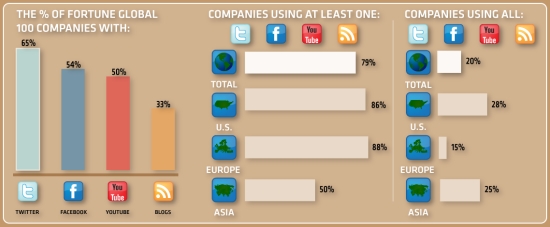
I happen to work for a Fortune 100 company (Intel) and I would say that the following infograph is a fairly accurate representation of most companies with regards to their Social Media participation. I think Intel is a bit different and we’ve been recognized as an early (and often) adopter of Social Media within our marketing and media campaign efforts. The graphic below is a small snippet of the full infograph – click for expanded version.
It’s no secret – 2010 is the year of the Mobile Phone – every analyst, journalist, and pundit are stating their case on why this is the year that mobile finally rings the proverbial bell of success. As a marketer, I certainly see that it is very important to focus on this ’emerging’ platform – people are using their mobile devices in more robust ways than ever and, sometimes, even abandoning their computer all together and relying on their handheld as their only ‘connected’ device. According to Mary Meeker’s Mobile Internet Report, the #1 driving force for the uptick in mobile is Social Networking (slide 30). The number of people accessing their favorite social network or taking a social ‘action’ on their mobile device has sky rocketed over the last year. Facebook is head and shoulders above the rest as she outlines. If you want a more visual portrayal of how Mobile and Social are converging, Flowtown has put together (as usual) a very compelling infograph…teaser below, click on the image for the full version.
Jess3 (Jesse Thomas) strikes again, and creates a fantastic video that shows us the ‘latest’ state of the internet… Kudos on a really interesting look at the trends and factoids in the social graph.
Social Networking is, as Charlene Li says ‘Like Air‘ – ubiquitous and everywhere. We are in a culture where every demographic on the planet is involved in some capacity or another. Some of the most visible? Athletes – especially professional athletes. Social Media is a way for the athlete to share a little bit of their ‘off court’ or ‘off field’ persona with those that support them most – their fans. From a fan’s perspective, this is an amazing peek into the everyday lives of their sports heroes. Is it always good for the athlete? No.
Then, comes the flip side. Using social media to make a complete mockery of themselves. Case in point… this week, Portland’s own Greg Oden. There are multiple incidents that are embarrassing for athletes that have a very public persona – and some of the ramifications are career threatening, in the case of Gilbert Arenas. In many cases, it is simply kids making a mistake that is extraordinarily public (Brandon Jennings on Twitter and Video). Remember, these athletes are often times not even of drinking age but making millions of dollars…with plenty of free time on their hands. You know what they say about idle hands…
From my perspective, the moral here for professional athletes to take care with their use of Social Media. You have an incredible opportunity to extend your influence for good and to give the people that ultimately pay your salary (the fans) the ability to take a peek into your ‘off field’ persona. Be careful of what you ‘Tweet’ – it could come back to bite you…
According to a recent study done by the site Pingdom, women participate more than men in most social networking sites. The outliers? Slashdot, Reddit, and Digg – which does not surprise me at all, based on the content that is prevalent on those three sites. Pingdom has a nice graphic (below) showing the gender distribution across the Social Web. For the full blog post for this report, continue reading here.
Social Media Today has a great article this week on Social Media monitoring – breaking it down to 4 simple cornerstones:
(1) Competitive Analysis
(2) Product Development
(3) Reputation Management
(4) Outreach
(1) Competitive Analysis
(2) Product Development
(3) Reputation Management
(4) Outreach
From my vantage point – many companies do a great job in 3 of the 4 areas listed above. I think the one that falls short is ‘Product Development’…which is a big miss in my opinion. At Intel, one of our marketing groups launched a pilot for this about a year ago with a technology partner – Asus, and a media vendor that understand the space very well – Federated Media. The project? Crowdsource design a PC that will be built by Asus, with Intel Inside. For more, check out WePC.
I send out a weekly ‘newsletter’ of the 10 most compelling things that I read each week to a small group of people internally and some of my agency and media partners outside of Intel. One of the topics that I included was the title of this post. Inc. Magazine released a study last week that I found to be very interesting. What the study shows is that of the 500 fastest growing private companies in the U.S. an overwhelmingly large percentage of them are actively engaged with Social Media disciplines, tools, and/or activities:
“According to the study, social media usage by companies on the Inc. 500 has grown in the past year, with 91 percent of companies reporting that they use at least one social media tool, compared with 77 percent of companies surveyed in 2008. Of the six social media categories covered in the survey, the one that continues to be the most familiar to Inc. 500 companies is social networking, with 75 percent saying that they are “very familiar with it.”
What’s interesting about this study is that all companies surveyed were privately held – perhaps showing a higher tolerance for ‘risk’ associated with Social Media activities. Another quote that shows where the motivation lies for adopting new and compelling marketing disciplines states very simply:
“Inc. 500 companies are focused on doing anything they can to grow faster and social media is an innovative tool that may give them an edge over their competition”
In summary – stay on the forefront of marketing innovation to ensure you’re message stands out over the competition. Pretty simple, but many public companies are slow to recognize this and the value that Social Media contributes to that leadership message…

 Arguably, the 2010 World Cup will be the most watched sporting event in history. What’s unique about this edition of the largest futbol tournament in the world is how it will be activated on the social web. Try Google’ng ‘


 Social Networking is, as Charlene Li says ‘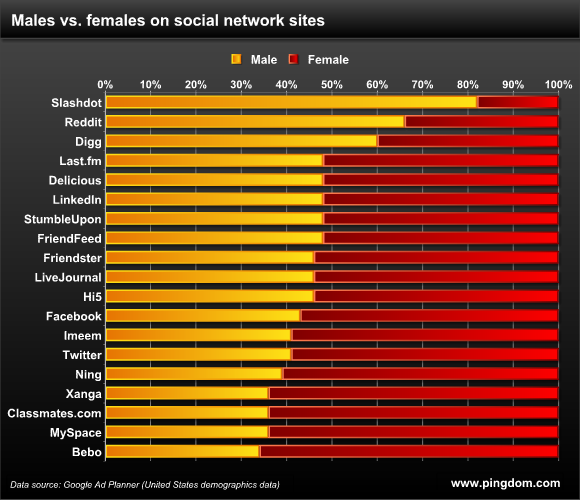
 Social Media Today has a